Tsukiji Fish Market – Just After 9 is the Right Time

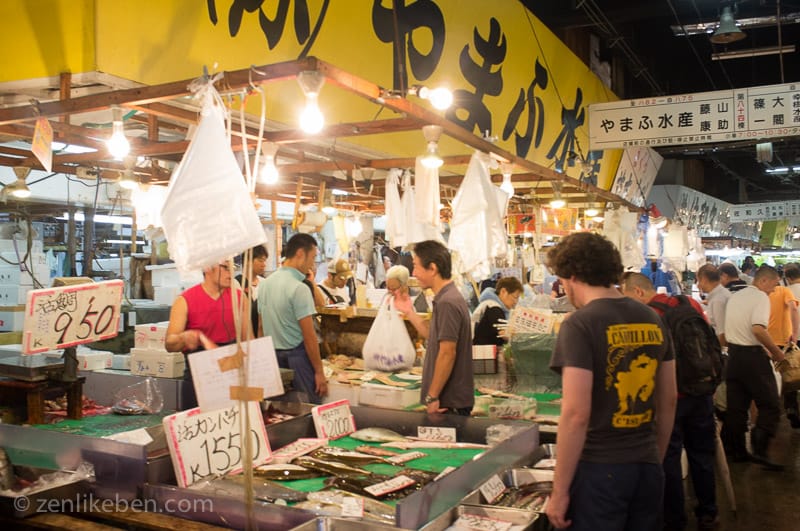
Looking at some fun things at the Tsukiji Fish Market

Who knows what fishes I’m looking at!  The Tsukiji market has so many strange and wild things!

The Tokyo Tsukiji Fish Market – where to even begin??!  It’s such a strange and wonderful place that it should be on the top of the list for anyone visiting Tokyo.  Full of chaos, wonder, and really strange things there is a reason so many people should go see it.

Not wanting to get up at 4am and catch a taxi to see the tuna auction (I’ll leave that for next time – some say it’s worth it and others say it’s not), we decided to instead wake up at the much later 6am to be at the market closer to 7am.  Which, in reality, was a little too early.  After grabbing an incredible sushi breakfast at Daiwa-Zushi, we still had about 45 minutes to kill before the markets opened to the public at 9am.  Perfect time to grab a quick cup of joe though – much needed after getting up so early!

A man carving some frozen tuna at the Tokyo Fish Market

A man carving frozen tuna at the Tokyo Fish Market

However, be ready though – if one wants to visit the main grounds do so no later then 9am.   As the market is just open to the public at that time, it’s been open to wholesalers for quite some time by that point.  Many sellers had already started packing up by the time we entered and a good quarter of the market was cleared out as we were leaving around 9:30~10am!  The lines for the sushi stands at that point had also almost tripled in size so I’d highly recommend visiting the sushi stands first before entering the market at 9am – so maybe getting up so early was not a bad idea after all?

Wandering around the market was quite a joy, and it was fun to be among the hustle and bustle of the most famous fish market in the world.  Being able to look down at things caught from all over the world was simply amazing, even if I didn’t understand what half of the things I was looking at!  For any sort of seafood fan, the Tokyo Tsukiji Market should be at the top of your list of places to visit while in Tokyo!

Posted in Travel | Tagged , | Leave a comment

Sushi, it’s what’s for Breakfast

One of the chefs at Daiwa-Zushi

One of the chefs at Daiwa-Zushi

Waking up at 5:30 am is tough.  Really tough but it’s what you have to do to if you want to experience what is the chaos of the Tokyo Fish Market.

Actually I lied – we snoozed so we didn’t hit the market until 7 am – but that was just perfect to grab a quick sushi breakfast before the market opens to the general public at 9 am.

Daiwa-Sushi: Sushi lovers heaven

The main sign for Daiwa-Zushi

The main sign for Daiwa-Zushi – look for the faded red curtains above the door

Seeing the line wrapped around the building for the infamous Sushi Dai, we decided instead to less popular but just as good Daiwa-Sushi.  Daiwa is supposedly the son of the chef at Sushi Dai.  I noticed the much shorter line for Daiwa-Sushi was made of primarily locals – so maybe they are on to something the tourist haven’t quite caught on to.  The wait at 7 am was a brisk 30 or so minutes before we were quickly seated at the sushi bar.  Pay attention while your standing in line as the line attendant will get a little pushy if you don’t move quickly enough!

Toro at Daiwa-Zushi

The fattest chuck of toro I’ve ever seen!

We decided to order the omakase (chef’s choice) which was a selection of what was the freshest for that morning.  The omakase at Daiwa-Zushi runs about 3500 yen ($35 US) consisted of 7 pieces of nigiri and two-three piece rolls.  The omakase also included miso soup and green tea.

It quickly became apparent why the line was moving so quickly, within a few seconds of ordering we had our first piece of sushi:  quite possibly the fattiest looking toro (the fatty part of the tuna) I have ever seen.  It literally melted in our mouths!

Uni from Daiwa-Zushi

The Uni from Daiwa-Zushi was absolutely delicious!

Next came the Uni and, WOW, was it good, way better than anything back home.  After the Uni came shrimp, then buri (adult yellowtail), anago (sea water eel), regular tuna, sweet egg, three pieces of tuna maki and three pieces of salmon roe maki.  I also ordered a piece of scallop (one of my favorite types of sushi) and it was on the same level as everything else.

While the sushi was not quite as good as what I had at Yosada (The rice alone at Yosada was on a different level), it still was amazing.  Also surprisingly good was the miso soup.  Packed with tiny clams, it was hands down some of the best miso I’ve ever had.

Daiwa-sushi was well worth the wait and price.  It should be on anyone’s list of places to go while visiting the fish-market.  Even for those not interested in going to the market, Daiwa should be on any sushi lovers bucket list – YUM is all I can say!

Posted in Food, Restaurants, Travel | Tagged , , | 3 Comments

Yasuda – Raw Fish from the Iron Fist

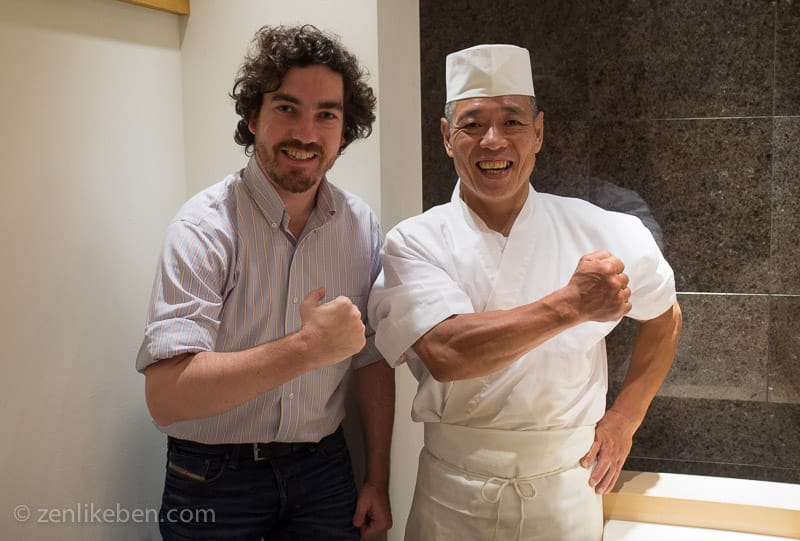
Me and Yasuda-san

Me and Yasuda – I’m just as ripped, right?

Several weeks ago I was lucky enough to score a reservation at the critically acclaimed sushi bar founded by Naomichi Yasuda.  Yasuda-san, originally from Japan, has recently returned after spending 25+ years in New York to try his luck in the Tokyo sushi scene. As the only time we could get was the day we arrived, we decided to push through the tiredness and go to our reservation.  A decision I will never regret – Yasuda was hands down the best sushi I have ever or will likely ever have again.  Yasuda-san was extremely friendly and jovial and kept referring to his sushi bar as a “Sushi Public House” – there were no rules except his request you eat your sushi quickly (as the flavor changes as it warms up) and try to eat it in one bite.

Eel at Yasuda

Yasuda completely changed my opinion on Eel.

Yasuda-san, a former kyokushin karate competitor, still practices and talked to us how his fighting stance and the concentration one gets in karate training is helpful in preparing sushi.  He took care to explain everything we were eating and went into so much detail sometimes even I had trouble figuring out what he was talking about sometimes.  This guy knows his sushi!  For instance he has developed his own method for the preservation of fresh fish.  He’s found that deep freezing fish to a specific temperature preserves both it’s taste and flavor.  While I’m no expert, the fish he told us he had previosuly frozen tasted like it had been caught that day.  He will also age certain fish to fully allow the flavors to develop.  Certain fish he states is not good if eaten the day it was caught,

The oyster from Yasuda

The oyster was the last thing Yasuda served and his personnel favorite

To Yasuda-san, the rice is the most important part of sushi preparation.  Which, if you think about it, makes a lot sense.  Anyone can go to the market and pick fresh fish but the flavor and amount of rice with the sushi completely changes the taste of the fish.    He went on to explain that even the pressure used to press the fish in a ball to form the nigiri is important.  Yasuda kept telling us no-one trained him how to make great sushi.  When asked how he became who he was today, he simply replied “By listening to my customer!”  Yasuda went on to claim there is no difference between Japanese sushi and American sushi.  He stated there are only two types of sushi: Good and bad.

Uni from Yasuda

Just one of the four types of Uni I tried at Yasuda!

Knowing I was a Uni fan, he was proud to tell me he had 4 different types of Uni that day – and WOW is all I can say.  This place was heaven.  I highly recommend anyone in Tokyo that enjoys sushi to go.  Both because of his style of explanation and the quality and intimacy of his sushi.  This place is nothing short of amazing and should be on any sushi aficionados list while traveling to Tokyo.

Posted in Restaurants, Travel | Tagged , , | 6 Comments

Butting Heads with Swiss Cows

Numbered cows fight until only one remains

Numbered cows fight until only one remains

Staying at Au Club Alpin in Champex-Lac, Switzerland turned out to be one of my all time travel experiences to date. Champex-Lac is a sleepy, ski town that during the summertime receives little summer visitors. While we had anticipated just using the time to hike, we were unprepared for what happened next.

Our host at Au Club Alpin spoke fluent english, which was surprising given that almost no-one else in the town spoke anything but French. When we asked him if there is anything local we could experience he thought for a moment and then his eyes lit up and he belted out “Yes!! You must experience Combats de Reines, the Fighting Cows!!!”

Swiss Cows waiting for their chance to fight

Swiss Cows waiting for their chance to fight.

“What?!” We asked. “The Fighting Cows, very Swiss, very local” is all he replied. The then hurried to the kitchen and gave us some of this stinkiest, most pungent cheese I have ever tasted. All we could do was muster a half-hearted “Mmmm” as we tried to stomach the cheese while he explained just exactly what Combats de Reines was.

“The fighting cows,” as he went on, “are the female cows from farmers in the area. “The cows naturally stake out the best piece of grass in the pasture for their calves and fight off any other female cow that would try and take it.”

During the summer months they would gather their burliest females and throw them in a pasture to watch them fight. The cows would travel around to various towns and compete until one became the La Reine des Reines or the Queen of the Queens.

Lots of down time.  A majority of the time the cows were just happily eating grass.

Lots of down time. A majority of the time the cows were just happily eating grass.

Our host graciously began calling his friends and soon found out the cows were only a few towns away. Pointing out where it was on a map we were soon off to find the Fighting Queens.

Not knowing what quite to expect, I was imagining something grandeur –  an arena with throngs of cheering fans yelling and throwing roses.  I was more surprised to find just few dozen people lazily standing around a pasture drinking beers and watching cows eat grass.  Every once in a while a gentlemen would come, poke a cow with a stick to get them to fight.  The loser would be escorted out.  The pasture was framed by a glacier delicately hanging just a few thousand feet above.  Switzerland really is beautiful!

The throngs of crowds at Combats de Reines

The throngs of crowds at Combats de Reines.

“Combats de Reines?” I asked someone.

They turned to me and seemed to be amazed two Americans were even at this.  To the Swiss Combats de Reines is a tradition dating back centuries that’s more of a way to pass time then something one should go out of the way to see ( Although now I will note serious prize money can be won and thus its also a source of income for the farmers).

They quickly questioned how we had stumbled upon such a spectacle, wondering if we had come specifically to Switzerland to watch the cow fights.  Satisfied that we were here merely by chance, they turned back to their conversation leaving us to take in one of the most random, fun, and unexpected journeys I’ve had while traveling.

Posted in Travel | Tagged , | Leave a comment

Photo of the Week – Fireworks

Fireworks in DC on July 4th 2013

I’ve been really getting into the RAW processing tool – DXO Optics. Reading their tutorial on how to adjust the program for fireworks, I was inspired to touch up a old photo I took back in 2013.

DXO does an amazing job in allowing the colors to “pop” in the photo without looking too processed.  In addition it helps reduce noise and correct for optics distortion – an amazing difference!  I highly recommend it for any photographer half-way serious about their photos.

Posted in Travel | Tagged | Leave a comment

Photo of the Week – The Temple of the Three Windows at Machu Picchu

The Temple of the Three Windows - Machu Picchu
It is believed that the Temple of Three windows (previously five in total) represented the three mythological caves from which the Ayar brothers, children of the sun, stepped into the world.

Inside the remains of the temple is a carved stone with engravings that represent the three levels where the Inca civilization divided the Andean world: the sky spirituality (Hanan-Pacha), the Earth’s surface or the mundane (Kay-Pacha) and subsoil or inner life (Ukju-Pacha). Shards of smashed pottery were found beneath the temple perhaps indicating that pots would have been ritually broken here.

Posted in Photography, Travel | Tagged , , | Leave a comment